
Hoshin Kanri: How to Turn Strategy into results and actually get things done

Resources
By
Viswesh Krishnamurthy
8 min read

Introduction

When meticulously crafted strategies fail, conventional wisdom blames "execution failure," a convenient catch-all that obscures the deeper truth. Most organizations fundamentally misunderstand how to deploy strategy. They confuse activity with progress, and cascade objectives without truly aligning the organization's daily work. This isn't just execution failure, but it's a systemic breakdown in the strategy deployment process.

Hoshin Kanri

Hoshin Kanri (Japanese) loosely translates to "policy deployment". It is a rigorous, holistic framework that originated in post-war Japan, famously adopted by companies like Toyota and Hewlett-Packard. It's not just about setting goals, but about creating a living, breathing system where every individual's work directly contributes to breakthrough objectives, ensuring that the organization moves as one coherent force towards its strategic north star. It challenges the top-down mandate by forcing a dialogue, a "catchball" process, that ensures understanding, buy-in, and capability at every level.

The core problem Hoshin Kanri addresses is the pervasive disconnect between executive vision and operational reality. Harvard Business School's research shows that about 90% organizations fail to execute their strategies. Hoshin Kanri fixes that by institutionalizing a disciplined approach to strategic planning, deployment, and review, moving strategy from a static document to a dynamic, organizational operating system.

Foundational Pillars

Hoshin Kanri is a philosophy embodied in a systematic process. Here are its foundational pillars,

Define Breakthrough Objectives (Long-Term Vision & Annual Goals):

This isn't just about setting ambitious targets but about identifying a few critical, game changing objectives that will propel the organization forward over a 3 to 5 year horizon, then translating these into specific, measurable annual goals. These are the "Hoshins", the guiding stars. The clarity here is paramount. As VF Ridgway noted, "What gets measured gets managed even when it's pointless to measure and manage it, and even if it harms the purpose of the organization to do so." Hoshin Kanri solves this by ensuring what gets measured actually "matters" to the organization.

"Catchball" for Alignment and Buy-in:

This is the heart of Hoshin Kanri's contrarian approach. Instead of simply dictating goals, senior leadership proposes the Hoshins, then engages in a rigorous, iterative dialogue ("catchball") with middle management and operational teams. This back-and-forth ensures that objectives are understood, refined, and translated into actionable sub-goals and metrics at each level. It's a negotiation that builds ownership, surfaces potential obstacles, and ensures that the "how" is as robust as the "what."

Deploy and Execute with Metrics (X-Matrix & Action Plans):

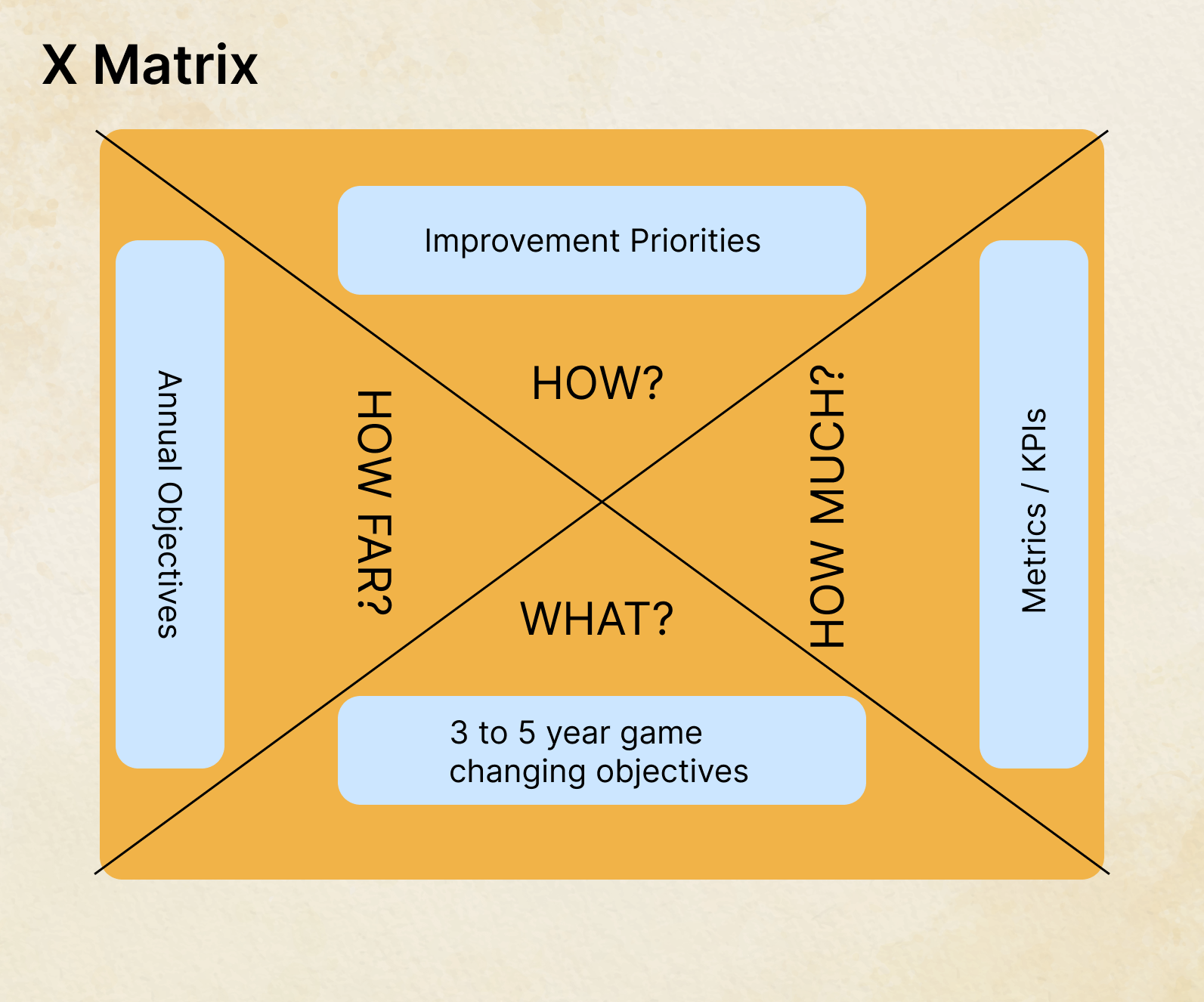
Once alignment is achieved, the strategy is deployed through detailed action plans. The X-Matrix is a powerful visual tool that connects long-term objectives, annual goals, improvement priorities, and key metrics with specific owners and resources. Every initiative, every project, every daily task must be traceable back to a strategic objective. This provides unparalleled transparency and accountability, ensuring that resources are allocated where they will have the greatest strategic impact.
Regular Review and Adjustment (PDCA Cycle):

Hoshin Kanri is not "set it" and "forget it". It mandates frequent, structured reviews, typically monthly and annually, to assess progress, identify deviations, and course correct. This Plan-Do-Check-Act (PDCA) cycle is embedded at every level, fostering a culture of continuous improvement and strategic learning. It's about asking, "Are we on track?" If not, why? What adjustments are needed? This iterative feedback loop is what makes Hoshin Kanri resilient and adaptive.

How to Implement Hoshin with Tesoract

Tesoract's architecture and features are remarkably well-suited to support the core principles of strategic alignment, deployment, and execution that define Hoshin Kanri. Tesoract integrates strategy, OKRs, projects, and ideas into a cohesive platform, directly addressing the fragmentation Hoshin Kanri seeks to eliminate.

Define Strategy / Breakthrough Objectives

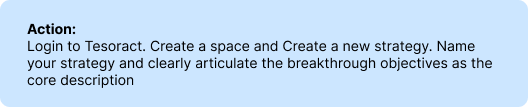
In Tesoract, your "Strategy" is the foundational element. You would create a new strategy and define your overarching breakthrough objectives within it. This serves as your guiding star. Learn more about writing solid strategies here.
Translate Breakthrough Objectives into Measurable OKRs

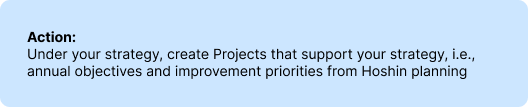
Hoshin Kanri's annual objectives and improvement priorities translate directly into Tesoract's OKR framework. In Tesoract there can never be an unaligned OKR and every objective and key result contributes to your defined strategy. Learn more about defining OKRs here.

Align Projects and Initiatives

Projects in Tesoract help mange outputs that support the strategy. Tesoract allows you to manage projects in the project management methodology of your choice.
"Catchball" and Collaboration

Tesoract's "Idea Hubs" supports the "catchball" process by providing structure for teams to generate, discuss, and prioritize ideas related to achieving strategic objectives and solving operational challenges. This is crucial for bottom-up input and problem-solving.

Monitor Progress and Course-Correct:

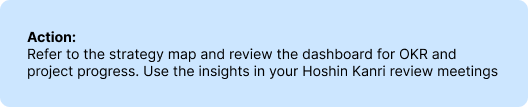
Tesoract's strategy map and the dashboard features provide the essential "Check" and "Act" components of the PDCA cycle. The strategy map shows a visual relationship mapping of strategies and its related items such as ideas, OKRs and Projects. The dashboard shows aggregated and granular progress of OKRs and Projects needed for regular reviews and data-driven adjustments.
Closing thoughts

While Hoshin Kanri is not a silver bullet, it is a proven methodology for forging an unbreakable link between your highest-level vision and the daily work of your teams. It demands discipline, dialogue, and an unwavering commitment to alignment.

We believe every business, no matter the size, can achieve strategic clarity and impact when armed with the right tools. If that resonates with you, let’s talk about how we can make it happen. Get in touch with us today.

Back

Hoshin Kanri: How to Turn Strategy into results and actually get things done

Viswesh Krishnamurthy
For - Strategy & Transformation Leaders
Resources
8 min read
December 1, 2025

Introduction

When meticulously crafted strategies fail, conventional wisdom blames "execution failure," a convenient catch-all that obscures the deeper truth. Most organizations fundamentally misunderstand how to deploy strategy. They confuse activity with progress, and cascade objectives without truly aligning the organization's daily work. This isn't just execution failure, but it's a systemic breakdown in the strategy deployment process.

Hoshin Kanri

Hoshin Kanri (Japanese) loosely translates to "policy deployment". It is a rigorous, holistic framework that originated in post-war Japan, famously adopted by companies like Toyota and Hewlett-Packard. It's not just about setting goals, but about creating a living, breathing system where every individual's work directly contributes to breakthrough objectives, ensuring that the organization moves as one coherent force towards its strategic north star. It challenges the top-down mandate by forcing a dialogue, a "catchball" process, that ensures understanding, buy-in, and capability at every level.

The core problem Hoshin Kanri addresses is the pervasive disconnect between executive vision and operational reality. Harvard Business School's research shows that about 90% organizations fail to execute their strategies. Hoshin Kanri fixes that by institutionalizing a disciplined approach to strategic planning, deployment, and review, moving strategy from a static document to a dynamic, organizational operating system.

Foundational Pillars

Hoshin Kanri is a philosophy embodied in a systematic process. Here are its foundational pillars,

Define Breakthrough Objectives (Long-Term Vision & Annual Goals):

This isn't just about setting ambitious targets but about identifying a few critical, game changing objectives that will propel the organization forward over a 3 to 5 year horizon, then translating these into specific, measurable annual goals. These are the "Hoshins", the guiding stars. The clarity here is paramount. As VF Ridgway noted, "What gets measured gets managed even when it's pointless to measure and manage it, and even if it harms the purpose of the organization to do so." Hoshin Kanri solves this by ensuring what gets measured actually "matters" to the organization.

"Catchball" for Alignment and Buy-in:

This is the heart of Hoshin Kanri's contrarian approach. Instead of simply dictating goals, senior leadership proposes the Hoshins, then engages in a rigorous, iterative dialogue ("catchball") with middle management and operational teams. This back-and-forth ensures that objectives are understood, refined, and translated into actionable sub-goals and metrics at each level. It's a negotiation that builds ownership, surfaces potential obstacles, and ensures that the "how" is as robust as the "what."

Deploy and Execute with Metrics (X-Matrix & Action Plans):

Once alignment is achieved, the strategy is deployed through detailed action plans. The X-Matrix is a powerful visual tool that connects long-term objectives, annual goals, improvement priorities, and key metrics with specific owners and resources. Every initiative, every project, every daily task must be traceable back to a strategic objective. This provides unparalleled transparency and accountability, ensuring that resources are allocated where they will have the greatest strategic impact.

Regular Review and Adjustment (PDCA Cycle):

Hoshin Kanri is not "set it" and "forget it". It mandates frequent, structured reviews, typically monthly and annually, to assess progress, identify deviations, and course correct. This Plan-Do-Check-Act (PDCA) cycle is embedded at every level, fostering a culture of continuous improvement and strategic learning. It's about asking, "Are we on track?" If not, why? What adjustments are needed? This iterative feedback loop is what makes Hoshin Kanri resilient and adaptive.

How to Implement Hoshin with Tesoract

Tesoract's architecture and features are remarkably well-suited to support the core principles of strategic alignment, deployment, and execution that define Hoshin Kanri. Tesoract integrates strategy, OKRs, projects, and ideas into a cohesive platform, directly addressing the fragmentation Hoshin Kanri seeks to eliminate.

Define Strategy / Breakthrough Objectives

In Tesoract, your "Strategy" is the foundational element. You would create a new strategy and define your overarching breakthrough objectives within it. This serves as your guiding star. Learn more about writing solid strategies here.

Translate Breakthrough Objectives into Measurable OKRs

Hoshin Kanri's annual objectives and improvement priorities translate directly into Tesoract's OKR framework. In Tesoract there can never be an unaligned OKR and every objective and key result contributes to your defined strategy. Learn more about defining OKRs here.

Align Projects and Initiatives

Projects in Tesoract help mange outputs that support the strategy. Tesoract allows you to manage projects in the project management methodology of your choice.

"Catchball" and Collaboration

Tesoract's "Idea Hubs" supports the "catchball" process by providing structure for teams to generate, discuss, and prioritize ideas related to achieving strategic objectives and solving operational challenges. This is crucial for bottom-up input and problem-solving.

Monitor Progress and Course-Correct:

Tesoract's strategy map and the dashboard features provide the essential "Check" and "Act" components of the PDCA cycle. The strategy map shows a visual relationship mapping of strategies and its related items such as ideas, OKRs and Projects. The dashboard shows aggregated and granular progress of OKRs and Projects needed for regular reviews and data-driven adjustments.

Closing thoughts

While Hoshin Kanri is not a silver bullet, it is a proven methodology for forging an unbreakable link between your highest-level vision and the daily work of your teams. It demands discipline, dialogue, and an unwavering commitment to alignment.

We believe every business, no matter the size, can achieve strategic clarity and impact when armed with the right tools. If that resonates with you, let’s talk about how we can make it happen. Get in touch with us today.